In the competitive world of ecommerce, many store owners hit a sales plateau despite solid products and marketing efforts. You optimize listings, run ads, and tweak designs, yet conversions stall. Sound familiar? The truth is, intermediate sellers like you often overlook proven strategies that deliver immediate results. Revenue growth demands more than guesswork; it requires actionable insights backed by data and real-world success.
Enter our guide to tips to increase ecommerce sales. This post reveals 12 proven tips, each battle-tested across thousands of stores, to unlock more ecommerce sales without overhauling your entire operation. From refining product pages and leveraging urgency tactics to mastering upsell funnels and email retargeting, these strategies target high-impact areas intermediates can implement today.
Expect step-by-step explanations, real examples, and metrics to track your progress. Whether you aim to boost average order value by 20 percent or double your repeat customers, these tips provide the authoritative blueprint you need. Dive in, apply them, and watch your sales climb. Your next revenue breakthrough starts here.
1. Recover Abandoned Carts Aggressively
Over 70% of shoppers abandon their carts before completing a purchase, according to 2026 Netpeak data and Baymard Institute’s analysis of 50 studies showing a global average of 70.22%. This crisis represents massive recoverable revenue, potentially $260 billion in key markets like the US and EU, as these visitors exhibit high purchase intent. For Shopify stores, aggressive recovery tactics can reclaim 10-20% of lost sales, directly boosting profitability by turning window-shoppers into buyers.
Implement multi-step email flows starting 1 hour post-abandonment for peak engagement. The first email features personalized reminders with exact cart items, including product images, names, prices, and quantities via dynamic blocks. Follow up at 24 hours with a 5% discount expiring soon, then at 72 hours with 10% off or free shipping for high-value carts. Segment by buyer type, such as new vs. repeat customers, and send during peak times like 8 PM for 35-50% open rates.
Layer in SMS and push notifications, which boast 98% open rates compared to email’s 20-30%. Trigger SMS 15-20 minutes after abandonment with urgent messages like “Your cart awaits, 15% off in 1 hour,” including one-click links. Push notifications deliver instant reminders with time-sensitive offers, achieving 8-15% conversions when combined multichannel.
Incorporate dynamic recommendations tied to cart contents, such as “Pair these shoes with matching accessories,” to reignite intent and increase average order value. Use AI-driven upsells from the same category, synced with real-time inventory.
Track everything in Shopify Analytics under Abandoned Checkouts for recovery rates, sales uplift, and AOV. Refine flows by testing timings and incentives, measuring ROI to cut waste and scale wins. This approach can deliver 20%+ recovery rates in 2026.
2. Implement Dynamic Upsells and Cross-Sells
Dynamic upsells and cross-sells represent a proven strategy to increase ecommerce sales by elevating average order value without acquiring new customers. According to the Netpeak 2026 Digital E-Commerce Marketing Guide, these tactics deliver an average 42% revenue boost through personalized recommendations at high-intent moments, leveraging purchase data and AI for relevance. For intermediate ecommerce operators, especially on Shopify, this means turning one-time buyers into higher-value transactions seamlessly.
1. Deploy Pop-Ups on Product Pages, Cart, and Checkout. Trigger subtle pop-ups suggesting premium versions or bundles exactly when momentum peaks. On product pages, offer an upgraded model with feature comparisons; in the cart, propose a deluxe swap; at checkout, bundle accessories at a discount. These capitalize on decision-making psychology, often lifting order values by 20-30% when A/B tested for timing and messaging.
2. Integrate ‘Customers Also Bought’ Sections with Shopify Apps. Add algorithm-driven widgets showing complementary items based on real behaviors, like accessories for electronics. Shopify apps enable dynamic personalization for large catalogs, ensuring relevance and boosting cross-sells by mimicking trusted retail patterns.
3. Test Urgency Messaging for Immediate Action. Phrases like “Limited stock, upgrade now” or “Only 3 left” create FOMO, increasing upsell conversions by 20-50%. Pair with real-time inventory for authenticity; A/B test variations to refine.
4. Analyze Post-Purchase Data for Personalization. Review acceptance rates and behaviors to tailor future emails or SMS offers, sustaining growth. Tools tracking lifetime value enable 3-4% ongoing upsell rates, compounding revenue.
At Happy Oak Ecommerce, we optimize these alongside ad efficiency to maximize Shopify profitability. (198 words)
3. Use Free Shipping Thresholds with FOMO
According to Drip research, 93% of shoppers buy more to qualify for free shipping, making thresholds a powerhouse tactic to lift average order value (AOV) and conversions. This psychological nudge exploits the goal gradient effect, where customers add items to close the gap, often increasing AOV by 15-30%. For intermediate ecommerce operators, implement dynamic progress bars across your site, header, and cart displaying “You’re $12.47 away from free shipping!” Pair these with quick-add product suggestions tailored to cart contents, such as complementary accessories for runners if shoes are in the basket. This combination can boost uptake by 15-25%, turning browsers into higher-value buyers without heavy discounts.
Amp up urgency by adding countdown timers on cart pages, like “Unlock free shipping in 10 minutes – add $15 now!” This FOMO layer reduces the typical 70% cart abandonment rate by 8-25%, as loss aversion prompts faster decisions. Set your threshold strategically using the 30% rule: multiply current AOV by 1.3 (e.g., $65 AOV becomes $85), ensuring it’s achievable with one or two items while covering shipping costs via your gross margin formula.
Monitor key metrics weekly, including AOV lift (target 15-30%), conversion rates, and qualification percentage (aim for 65%+). A/B test increments of $10-15 over 5,000 orders, adjusting dynamically; lower if abandonment spikes below threshold, raise if no lift occurs. For Shopify stores, this optimizes profits amid 79% mobile traffic, aligning with value-seeking trends in 2026.
4. Promote Subscriptions for Repeat Revenue
Subscriptions drive predictable revenue and boost customer lifetime value (LTV) by 3-5x compared to one-time buyers, with the global market projected to exceed $320-904 billion at 12% annual growth in 2026, per ReferralCandy’s 2026 guide.
- Position subscriptions on product pages highlighting savings and free shipping vs. one-time buys. Display side-by-side comparisons on PDPs, defaulting to subscriptions with 10-20% discounts, free shipping badges, and calculators showing yearly savings. Use tiered plans (Basic, Core, Premium) to anchor mid-tier choices, which 60-70% select, lifting average revenue per user (ARPU) 20-35%. Add social proof like testimonials and “skip anytime” assurances to reduce friction; this can 3-5x enrollment rates from 0.5-2% on cold traffic.
- Use Shopify apps like Recharge for seamless setup and management. Recharge powers 30K+ merchants with no-code portals, dynamic bundles, dunning recovery (60-80% churn recapture), and Klaviyo integration. Setup takes days, scaling LTV 12% YoY via analytics dashboards benchmarking churn and MRR.
- Offer introductory discounts to convert 20-30% of one-time buyers per industry benchmarks. Test 50% off first orders or $1 trials against full-price intros for better retention; pair with “subscribe & save” at 10-15% to hit 5-15% take rates, scaling to 25-40% on annual plans.
- Automate win-back campaigns for lapsed subscribers via email/SMS. Segment by RFM for 30/60/90-day flows with credits, surveys, and personalization; multi-channel automation yields 54% higher conversions and 2,361% lift per Digital Applied’s 2026 guide.
- Track lifetime value (LTV) improvements to justify expansion. Monitor ARPU/churn (target <5% monthly) and NRR >100%; cohort analysis reveals 23% retention gains, with LTV >3-4x CAC signaling scale. Use Recharge dashboards for quick ratios >4x before expanding.
5. Create Gift Guides and Product Quizzes
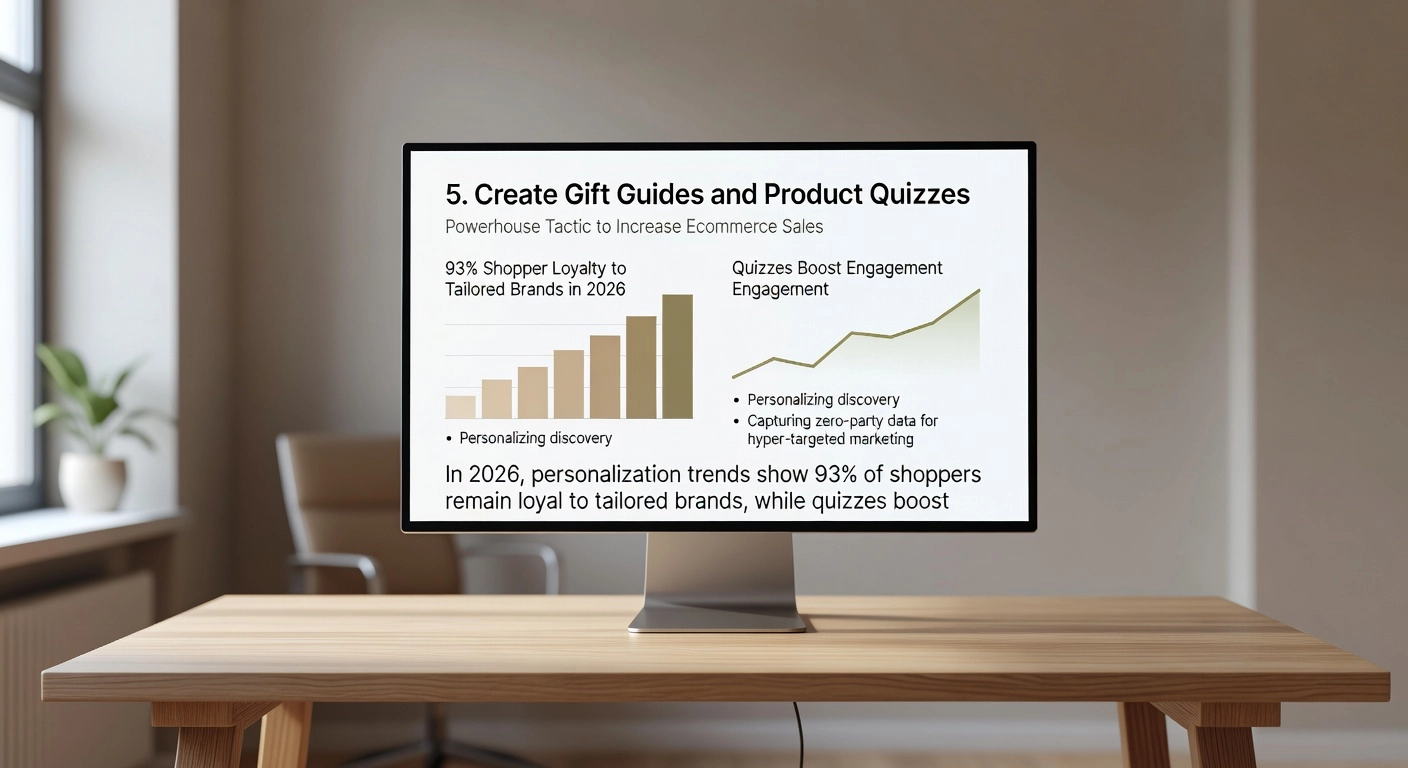
Creating gift guides and product quizzes stands as a powerhouse tactic among tips to increase ecommerce sales, personalizing discovery and capturing zero-party data for hyper-targeted marketing. In 2026, personalization trends show 93% of shoppers remain loyal to tailored brands, while quizzes boost conversions by 30-50% by easing decision fatigue.
1. Develop year-round gift guides with filters for occasions and budgets to drive discovery. Curate collections for birthdays, anniversaries, or back-to-school, featuring filters like “under $50 for him” or “eco-gifts for moms.” This uncovers hidden inventory, lifts average order value via bundles, and sustains traffic beyond holidays; publish 45-60 days early for SEO gains.
2. Implement quizzes capturing preferences for personalized recommendations and lead gen. Deploy 5-10 question quizzes on style, budget, or needs, gating results behind email opt-ins for 10-20% more leads. A subscription brand saw 24% higher conversions from taste-profile quizzes, per marketing stats.
3. Feed quiz data into remarketing audiences for targeted Google/Meta ads. Segment “style preferrers” or abandoners for dynamic ads, yielding 57% purchase lifts through privacy-compliant zero-party insights.
4. Integrate with Shopify for seamless purchase flows from quiz results. Use native apps for one-click adds from results to cart, enabling bundles and automated Klaviyo follow-ups.
5. Measure engagement via time-on-page and conversion attribution. Track completions, AOV uplift, and multi-touch ROI in Shopify Analytics/GA4; top performers see 25% revenue gains from personalized journeys, per ecommerce trends. This data fuels ad efficiency at Happy Oak Ecommerce.
6. Optimize Google Ads for High-Intent Traffic
Optimizing Google Ads channels high-intent traffic is among the top tips to increase ecommerce sales, especially as privacy changes and AI bidding reshape performance in 2026. Ecommerce businesses spending $20K+ monthly can achieve a baseline $2:$1 ROAS by focusing on precise targeting and waste reduction, per Netpeak’s 2026 benchmarks. This approach drives qualified visitors ready to buy, lowering customer acquisition costs (CAC) while scaling profits on platforms like Shopify.
- Target high-intent keywords for $2:$1 ROAS. Focus on bottom-funnel terms like “buy [product] now” or “best [product] [attribute]” using exact and phrase match types in Search campaigns, or feed-optimized titles in Shopping and Performance Max. Netpeak data shows this yields $2 revenue per $1 spent, aligning with break-even for 50% margins. Review search terms weekly to promote converters and pause underperformers. For example, segment brand vs. non-brand campaigns to capture 5x incremental ROI on category searches, per recent benchmarks.
- Conduct audits to eliminate 30-40% structural waste. Broad match overlaps, keyword cannibalization, and irrelevant expansions inflate CPCs and waste budgets. Happy Oak Ecommerce offers specialized audits for $20K+ spenders, pruning 30-40% of spend through search term analysis and campaign restructuring. Clients typically recover 15-30% budget while lifting conversions 20-50%. Start with 90-day historical data to identify pitfalls like “free” queries on premium products.
- Implement negative keywords and intent-based segmentation to reduce CAC. Build account-level lists (up to 10,000 for PMax) excluding terms like “free,” “used,” or “repair,” cutting waste 15-25%. Segment campaigns by intent: high for exact-match “purchase” queries, mid for Shopping, low for remarketing. This drops median ecommerce CAC from $45, with fashion niches seeing $15-25 reductions. Use custom labels for margins and stock levels to prioritize bestsellers.
- Use server-side tracking on Shopify for accurate attribution. Amid iOS restrictions and cookieless futures, traditional tracking loses 20-40% of conversions. Implement Shopify’s Customer Events API with Google Enhanced Conversions to send hashed first-party data server-side, recovering accuracy to within 5-10%. Map webhooks for purchase and add-to-cart events, deduping via order IDs. This ensures true ROAS visibility, essential for Shopify brands facing gaps between Google (120 orders) and platform data (180).
- Scale profitable campaigns with automated rules or agentic AI tools. After 30 conversions, enable Target ROAS bidding at 400%+ and allocate 50% more budget to winners. Set rules to pause low-ROAS terms; adopt agentic AI for autonomous budget shifts and creative tests, slashing CAC 27% on Shopify per recent guides. Blend 60% PMax for scale, 30% Search for control. Tools like Google’s AI agents handle 500+ SKUs, boosting profits 20-70% without added headcount. For expert optimization, partner with Happy Oak Ecommerce to streamline your Shopify ad efficiency.
7. Leverage Marketplaces Like Amazon and Walmart
Expanding your Shopify store to marketplaces like Amazon and Walmart ranks among the top tips to increase ecommerce sales by tapping into massive built-in traffic and trust. These platforms drive efficiency, with Amazon Sponsored Products yielding $3.67 in sales per $1 spent, per Netpeak’s 2026 analysis, and Walmart’s marketplace hitting $15 billion in GMV amid 27% ecommerce growth. Allocate budgets strategically by comparing marketplace ROAS (target 4:1+) against DTC (3:1+), focusing high-performers like health products where CPC rises but conversions hold strong, as detailed in the 2026 Amazon vs. Walmart benchmark report.
Optimize listings first: Craft keyword-rich titles under 80 characters (e.g., “Brand Wireless Earbuds Noise-Cancelling 30H Playtime”), add 6+ HD images (2,000px min), and deploy A+ Content with videos for 20% sales lifts. Sync inventory seamlessly via Shopify apps like Trunk for real-time updates across channels, preventing stockouts during Q4 surges that plague 60% of multi-channel sellers.
Run Sponsored Brands ads for top-of-search visibility and layer deals like Lightning Offers or Rollbacks to spur urgency; Walmart’s 14-day attribution boosts halo effects by 30% CVR. Analyze weekly TACoS to shift budgets from low-ROAS DTC to marketplaces, cutting waste and scaling profits with precision. This approach, per Amazon advertising stats, sustains 3x ROAS amid rising costs.
8. Partner with Influencers and Use UGC
Partnering with influencers and harnessing user-generated content (UGC) ranks among the most effective tips to increase ecommerce sales, delivering authenticity and social proof that traditional ads often lack. Micro-influencers, with 10,000 to 100,000 followers, generate up to $20 revenue per $1 spent, far surpassing macro-influencers due to their 6-10% engagement rates and peer-like trust, as detailed in the Influencer Marketing Benchmark Report. Prioritize authenticity by selecting creators whose niche aligns with your Shopify brand; co-create unboxing videos or tutorials, using hybrid compensation like fees plus 10-20% commissions. A cosmetics brand activated 700+ micro-influencers on TikTok and Instagram, achieving 33.9 million engagements and 80% lift in social search traffic.
Launch UGC challenges with branded hashtags to spark organic participation, yielding a 13% conversion lift according to Netpeak’s 2026 guide. Repurpose this content across ads, product pages, and emails for 35% higher engagement on pages and 4x click-through rates in ads. Track performance rigorously with unique promo codes or affiliate links, standard for 45.9% of campaigns, to measure ROAS accurately via tools like UTMs or Shopify apps. Finally, build long-term ambassador programs by tiering top performers from trials to ongoing partnerships, fostering 5.2x higher customer spend and sustained loyalty in 2026’s social commerce surge, per influencer ROI statistics. Start with 20-30 pilots to scale profitably.
9. Harness SMS, Push, and Affiliate Marketing
Harnessing SMS, push notifications, and affiliate marketing delivers outsized returns among tips to increase ecommerce sales, combining sky-high engagement with scalable partnerships. SMS achieves 98% open rates, with messages read in under three minutes, enabling flash sales, cart recovery at 13.8%, and ROI up to $130 per dollar spent. Push notifications complement this with 81% opt-in rates on Android, excelling in back-in-stock alerts and lifecycle automations that double welcome series conversions.
- Capitalize on 98% SMS open rates for timely promotions and reminders. Deploy SMS for abandoned cart nudges like “Complete your order now: 15% off expires in 1 hour,” recovering revenue from the 70% abandonment rate. Pair with push for real-time app engagement, such as personalized stock alerts, boosting impulse buys by 19%.
- Pair with affiliates driving 16% of sales through performance incentives. Affiliates account for 16% of ecommerce orders via 10-30% commissions; offer them exclusive SMS-gated codes to recapture traffic, lifting average order value by 27%.
- Segment lists for personalized flows like post-purchase upsells. Use behavioral data to target “Loved your sneakers? 15% off matching socks,” with order bumps converting at 26% and rollover offers at 37%, adding 10-30% to revenue.
- Comply with opt-in regulations using Shopify SMS apps. Apps like Postscript ensure TCPA/GDPR compliance via explicit consent pop-ups and “STOP” opt-outs, minimizing fines while achieving 84% opt-in rates.
- Measure incremental revenue attribution to refine partnerships. Apply A/B tests and multi-touch models to isolate affiliate lift, rewarding high-performers for 20% efficiency gains and optimized ROAS.
Integrate these via Shopify for seamless tracking, segmenting to cut waste and scale profits.
10. Build Referral Programs and Social Proof
Building robust referral programs and social proof stands as a cornerstone among tips to increase ecommerce sales, slashing customer acquisition costs by 25-70% while elevating lifetime value through trusted word-of-mouth. Referred customers convert 3-5x higher, spend 25% more initially, and show 16-37% better retention.
1. Launch post-delivery referrals with double-sided incentives. Time prompts 7 days after delivery, when satisfaction peaks and customers are 83% likely to refer. Integrate calls-to-action in confirmation emails, unboxing inserts, and dashboards for 3x higher share rates. Double-sided rewards (e.g., 10-20% off both sides, matched to average order value like $10-30 for $100-200 AOV) outperform one-sided by 2-3x, yielding 12-18% shares and 15-22% friend conversions. Examples include $15 off for Allbirds or $75 gift cards for Casper.
2. Embed testimonials in emails, subject lines, and sold-out pages. Use snippets like “Sarah loved it, 20% off yours?” in subjects and video testimonials on sold-out pages for 34-80% conversion lifts. Five reviews alone boost purchase likelihood 270%.
3. Incorporate UGC and reviews site-wide for trust signals. Feature photos, videos, and 11-50 reviews on homepage, product pages, and checkout to drive 102-380% conversion gains; 93% of shoppers read reviews first.
4. Use Shopify apps like ReferralCandy for automation. This tool handles popups, rewards, fraud protection, and integrations, turning 10-30% of revenue from referrals with easy setup.
5. Quantify referral ROI and testimonial impact. Expect 5-8x ROI (top 10-30x), CAC at $15-45 versus $50-150 for ads; testimonials add 34-270% conversions. Track via analytics for iterative gains.
11. Surprise Customers to Drive Loyalty
Surprise customers to drive loyalty ranks among the top tips to increase ecommerce sales, transforming one-time buyers into vocal advocates who fuel repeat revenue and organic growth. In 2026, this high-ROI approach counters rising customer acquisition costs, which are 5-25x higher than retention efforts; a mere 5% retention boost can lift profits by 25-95%, with repeat customers spending 67% more and generating up to 65% of revenue.
1. Include free samples or upgrades in orders to create delight and advocacy. Slip in low-cost freebies like product samples, care items, or complimentary upgrades, such as shoe cream with boots. These gestures spark joy, introduce complementary products, and turn recipients into promoters; loyalty members spend 12-18% more, with redeemers yielding 115% higher revenue per customer.
2. Personalize based on purchase history via Shopify data. Use Shopify’s first-party data on past buys and browsing for tailored surprises like birthday rewards or reordering prompts. Skincare brands achieve 35% repeat purchase lifts by matching custom formulations; 71% of consumers expect this, driving 38% higher spending and 60% more repeat buys.
3. Share stories on social for viral potential. Reward unboxing videos and UGC shares to amplify delight virally. Post-purchase prompts boost shopper confidence in 69% of cases, with referred customers 4x more likely to buy and 16% higher lifetime value.
4. Track Net Promoter Score (NPS) improvements and repeat purchase rates. Monitor NPS via surveys alongside repeat rates (average 15-30%, top brands 62%) and frequency. VIP redeemers hit 50%+ repeats, 73% higher average order value, and 3.6x purchase cadence.
5. Budget 1-2% of revenue for these high-ROI initiatives. Allocate modestly to low-cost surprises, as retention costs 5x less than acquisition and delivers 1.8-4.9x ROI. Prioritize Shopify apps for scalable execution, A/B testing winners to maximize loyalty.
12. Optimize Shopify with Mobile and Agentic AI
Optimizing your Shopify store for mobile dominance and agentic AI stands as a pivotal tip to increase ecommerce sales in 2026, where privacy shifts and rising ad costs demand efficiency. With 79% of traffic originating from mobile devices according to Stormy.ai 2026 data, prioritize user experience tweaks like thumb-friendly buttons at least 44×44 pixels and page loads under 3 seconds to reduce bounce rates by up to 90%. Implement server-side tracking alongside agentic AI, autonomous systems that proactively manage ad workflows, to capture accurate revenue signals and slash customer acquisition costs by 27%. These AI agents automatically test creative variants using multi-armed bandit algorithms, sourcing user-generated content for freshness, then dynamically shift budgets from underperformers to high-ROAS winners for sustained scaling.
Happy Oak Ecommerce specializes in helping Shopify brands eliminate 30-40% ad waste through structural audits, optimizing Google campaigns for high-intent traffic while integrating these AI efficiencies to boost profits without inflated spending. Finally, monitor core web vitals, including Largest Contentful Paint under 2.5 seconds, Cumulative Layout Shift below 0.1, and Interaction to Next Paint under 200 milliseconds, via Shopify’s real-user monitoring dashboards. Each second faster in loading improves conversion rates by 7%, delivering compounded lifts when paired with AI-driven personalization. Actionable steps include auditing apps, compressing images to WebP format, and deferring non-critical JavaScript; brands achieving passing vitals have seen revenue surges up to 183%. This holistic approach ensures your store thrives amid agentic commerce trends, turning mobile visitors into loyal buyers.
Actionable Takeaways to Scale Profitably
In the $6.88 trillion global ecommerce landscape projected for 2026, prioritize high-impact tactics like aggressive cart recovery, where over 70% of visitors abandon, and ad audits for immediate revenue lifts. These quick wins target structural inefficiencies, delivering fast ROAS improvements without massive overhauls.
Audit your current strategies against these 12 tips, benchmarking ROAS above $2:1, elevating AOV through upsells (up to 42% revenue boost), and extending LTV via subscriptions and referrals. Use Shopify’s built-in analytics to quantify gaps, such as low SMS open rates (98% potential) or unoptimized mobile traffic (79% of visits).
Commit to testing one change weekly, iterating with A/B data from Shopify dashboards to refine dynamically. Ad-heavy brands should pursue efficiency audits, reclaiming 30-40% wasted spend through structural fixes like server-side tracking and agentic AI for 27% CAC reductions.
Finally, integrate these into a full-funnel approach: top-of-funnel marketplaces and influencers feed mid-funnel quizzes and UGC, while bottom-funnel surprises compound profitability for sustainable scaling.
Conclusion
To wrap up, these 12 proven tips equip you with actionable strategies to shatter sales plateaus: refine product pages for instant conversions, deploy urgency tactics like scarcity to drive impulse buys, master upsell funnels to lift average order value by 20 percent or more, and leverage email retargeting to recapture lost revenue from cart abandoners.
This guide delivers battle-tested insights from thousands of stores, complete with step-by-step instructions and metrics for tracking success. No need for a full overhaul; small, targeted changes yield big results.
Ready to unlock more ecommerce sales? Pick your top three tips, implement them this week, and monitor your dashboard for the surge. Your revenue growth starts now; seize it and watch your store thrive.