Imagine hitting a revenue plateau with your Shopify store. Orders slow despite your best efforts at marketing and product tweaks. You know the basics, yet true growth slips away. This is the reality for many intermediate store owners ready to scale but lacking a proven roadmap.
Enter shopify scaling done right. This comprehensive 6-step framework transforms stagnant operations into a high-growth machine. Backed by real-world results from stores that have doubled revenue in months, it cuts through the noise of generic advice. You will learn to systematically audit your store’s performance, streamline inventory and fulfillment, supercharge customer acquisition, refine conversion funnels, leverage data-driven automations, and implement sustainable expansion tactics.
By the end, you will have actionable steps to apply immediately. No fluff, just authoritative strategies tailored for Shopify users like you who demand results. Ready to unlock your store’s full potential? Let’s dive in.
The Shopify Scaling Landscape in 2026
Shopify’s Explosive Growth Signals Prime Scaling Opportunities
Shopify’s momentum into 2026 positions it as the ultimate platform for ambitious ecommerce merchants. In Q3 2025 alone, Gross Merchandise Volume (GMV) hit $92 billion, up 32% year-over-year, while full-year 2025 revenue approached $11.6 billion with 30% growth. Projections point to over $12 billion in revenue by 2026, fueled by a 29% compound annual growth rate (CAGR) from 2023. This surge, driven by AI tools, B2B expansion, and international markets, creates unmatched scaling windows. Merchants can capitalize by auditing unit economics early, targeting ROAS above 4:1 and LTV:CAC ratios exceeding 3:1. For instance, focusing on high-quality traffic via optimized ad campaigns prevents leaky buckets before aggressive spend increases. Shopify Q3 2025 financial results.
The Merchant Ecosystem: Vast Scale Meets Optimization Gaps
With 5.6 million live stores powering 875 million-plus unique buyers worldwide, Shopify dominates ecommerce. Yet, stark disparities reveal scaling hurdles: average conversion rates (CVR) hover at 1.4-1.8%, while the top 10% exceed 4.7%. This gap demands immediate action, such as speeding up site performance (aim for LCP under 2.5 seconds), adding product videos and trust signals, and implementing bundling to lift average order value (AOV). Intermediate merchants should benchmark against top performers by integrating apps for personalization, where 87% of stores use six or more. Real-world proof comes from Modern Nest, which boosted CVR from 1.8% to 3.1%, added $15k monthly from emails, and raised AOV from $65 to $85 for 15% net margins. Prioritize these fixes to join the elite before scaling traffic.
Shopify Plus Boom for High-Revenue Scalers
Shopify Plus exploded with 126% year-over-year growth, now supporting over 47,000 sites that represent 9% of the top 1 million websites. Tailored for stores reaching $800k monthly revenue, it unlocks 6,000 checkouts per minute, multi-store management, and ERP integrations. Upgrade when operations strain basic plans, automating fulfillment via 3PLs and CRM for retention. This shift often yields 15% revenue lifts and higher checkout CVR.
BFCM Records and Omnichannel Imperative
Black Friday Cyber Monday (BFCM) 2025 generated $14.6 billion in sales, up 27%, with 90% of merchants leveraging two-plus channels like Meta, Google, TikTok, and POS. Diversify now: build owned audiences via email/SMS, test creatives rigorously, and unify inventory to cut revenue leaks up to 5% from manual processes. Q4 2025 earnings insights. These trends demand omnichannel readiness for sustained Shopify scaling.
Key Metrics to Master Before Scaling
Conversion Rate: Hit 2-3% Minimum Before Scaling
Before pouring budget into Shopify scaling, benchmark your conversion rate (CVR) at a minimum of 2-3%, as averages hover at 1.4-1.8% across 5.6 million stores. Top performers exceed 4.7% in 2026 stats, driven by optimized funnels and tools like Shop Pay, which boosts CVR by +50% compared to guest checkout. Audit your site speed, product pages with videos and trust signals, and mobile UX, where 79% of traffic converts at just 1.8%. Action step: Enable Shop Pay and one-click options immediately; test urgency timers and social proof to lift add-to-cart rates to 7-10%. Track weekly via Shopify Analytics or Triple Whale benchmarks. Stores ignoring this leak 70% of carts to abandonment.
Unit Economics: Secure LTV:CAC >3:1
Positive unit economics demand an LTV:CAC ratio above 3:1, ensuring every acquisition dollar returns at least $3 in lifetime value. Calculate ROAS break-even as (AOV x gross margin) / CAC; scale ads only above 2.5-3x for 40% margins. For example, with $85 AOV and $38 Meta CPA, prioritize LTV bidding over short-term ROAS. Use 30/60/90-day cohorts in Shopify Reports to validate; below 3:1 signals unprofitable campaigns. At Happy Oak Ecommerce, we optimize these for clients by refining targeting and retention flows, avoiding cash burn during growth.
AOV, Checkout, and Retention Metrics
Boost average order value (AOV) to $95+ via bundling and cross-sells, which deliver 10-30% lifts; aim for 45% checkout completion, recovering the 55% abandonment with emails (10.7% recovery CVR). Track repeat purchase rate at 27% average, targeting 44% through loyalty and SMS. Implement post-purchase upsells and free shipping thresholds. Brentonway’s Shopify stats show BFCM AOV at $114.70 for winners.
Operations Efficiency Check
At 500+ orders monthly, manual reconciliation erodes up to 5% revenue via errors and stockouts. Automate inventory and fulfillment with 3PL partners for 25% cost cuts and >98% accuracy. Monitor fulfillment rates and returns (5-15% norm). Pre-scale audit prevents scaling pitfalls; CommerceBolt’s KPI guide stresses weekly tracking for resilience. Master these, and your Shopify store scales profitably.
Conduct a Comprehensive Pre-Scaling Audit
Before diving into aggressive Shopify scaling, perform a comprehensive pre-scaling audit to plug leaks in your store’s foundation. This step-by-step process ensures your site converts traffic efficiently, preventing wasted ad spend. Intermediate store owners should allocate 1-2 weeks for this audit, gathering tools like Google PageSpeed Insights, Google Analytics 4 (GA4), Shopify Analytics, and Hotjar for heatmaps. Expected outcomes include a 20-50% CVR uplift, LCP under 2.5 seconds, and ROAS stabilization above 3:1. Follow these four critical steps quarterly, especially before Q4 ramps.
Step 1: Evaluate Site Performance with Core Web Vitals Testing. Start by benchmarking speed, as every 100ms of latency drops sales by 1.6 percent. Run tests on your homepage and top product detail pages (PDPs) using Google PageSpeed Insights and Search Console’s Core Web Vitals report. Target LCP below 2.5 seconds (good score), CLS under 0.1, and INP under 200ms; only 65 percent of Shopify stores pass INP due to app overload. Red flags include mobile loads over 4 seconds or hero images exceeding 500KB. Optimize by converting images to WebP/AVIF for 50 percent size reduction, lazy-loading non-critical media, and removing unused apps. For detailed guidance, review this Shopify store audit for scaling founders. A 1-second improvement can boost CVR by 7 percent, adding thousands in monthly revenue for $50K stores.
Step 2: Optimize Product Pages for CVR Lift Using Videos, Trust Signals, and UGC. Audit your top 10 PDPs, where average Shopify CVR sits at 1.8 percent; aim to push it to 3.1 percent like Modern Nest, which scaled from $50K to $150K monthly. Add 5-6 high-angle photos, short UGC videos showing real use (80 percent better conversions), and trust badges like secure checkout icons above the fold. Incorporate reviews, FAQs, size guides to slash returns 12-18 percent, and “frequently bought together” bundles for AOV growth. Test sticky Add to Cart buttons and benefit-focused headlines via A/B tools like Shopify’s Draft Orders. Stack 3+ social proofs for a 34 percent CVR boost; pages with 50+ reviews convert 4.6 percent better. Track changes in GA4 events to confirm lifts before scaling traffic.
Step 3: Reduce Checkout Friction to Exceed 45 Percent Completion. Analyze your funnel in Shopify Analytics; average completion is 45 percent, with 70 percent abandonment. Enable Shop Pay immediately for a 9-18 percent overall impact and 50 percent CVR lift versus guest checkout, as it powers one-click mobile purchases (79 percent of sales). Implement one-page checkout, express buttons for Apple Pay/Google Pay, progress bars, and early shipping estimates without forced accounts, yielding 10-25 percent gains. Test cart drawers on mobile, where CVR lags at 1.8 percent versus desktop’s 3.9 percent. Use this Q1 2026 Shopify audit checklist for friction benchmarks. Post-optimization, expect 1.72x higher checkout-to-order rates.
Step 4: Audit Traffic Quality to Fix Low ROAS. Dive into GA4 and ad platform reports for funnel drop-offs; low ROAS often stems from broad targeting amplifying store flaws or creative fatigue, not ad limits. Verify UTM accuracy (revenue within 10 percent of Shopify), eliminate pixel duplicates, and segment by source; cold traffic to PDPs outperforms homepage blasts. Pause underperformers, refresh creatives pre-plateau, and test bundles on low-CVR segments. For structural waste like inefficient targeting, partner with experts in ad optimization to tighten audiences and cut spend by 20 percent while boosting profits. This ensures quality over volume, stabilizing LTV:CAC above 3:1.
With your audit complete, your Shopify store stands ready for sustainable scaling, minimizing leaky buckets and maximizing every visitor’s value. At Happy Oak Ecommerce, we specialize in these optimizations alongside targeted ad campaigns to drive profitable growth for your brand.
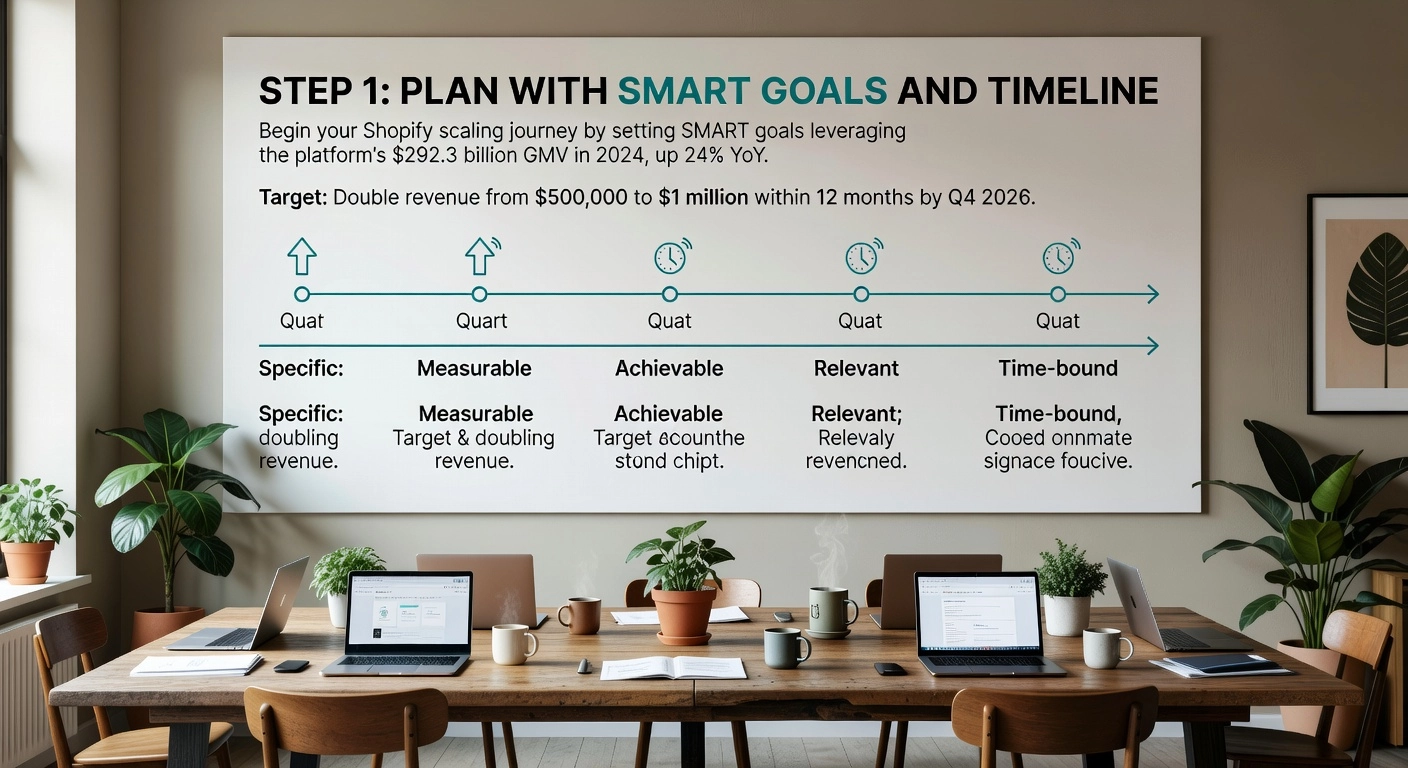
Step 1: Plan with SMART Goals and Timeline
Define SMART Goals Aligned with Platform Momentum
Begin your Shopify scaling journey by setting Specific, Measurable, Achievable, Relevant, and Time-bound (SMART) goals that leverage the platform’s $292.3 billion GMV in 2024, up 24% year-over-year. For instance, target doubling revenue from $500,000 to $1 million within 12 months by Q4 2026, capitalizing on trends like 32% quarterly GMV growth to $92 billion in Q3 2025. Another example: elevate conversion rate (CVR) to 3% by Q2 2026, surpassing the 1.4-1.8% average and approaching top 10% performers at over 4.7%. These goals must stem from your pre-scaling audit, ensuring relevance to unit economics like LTV:CAC above 3:1. Actionable step: Document goals in a shared dashboard using Shopify Analytics, reviewing quarterly against benchmarks such as average order value (AOV) rising to $120 from $85-92. Expected outcome: Crystal-clear direction that prevents scattered efforts and aligns with high-growth merchants achieving 126% year-over-year revenue via multi-channel strategies.
Craft a Detailed Scaling Roadmap
Next, map a 12-36 month timeline benchmarking current metrics against targets. Prerequisites include access to Shopify reports and tools like Google Sheets for projections. Compare CVR (current 1.5-2% post-audit) to 3%, ROAS to over 3x, and repeat purchase rate from 15% to 35%. Forecast cash flow by projecting monthly revenue times 30-60 day terms plus ad and inventory buffers; for $1 million GMV, anticipate capital needs met via options like Shopify Capital, which has funded over $3 billion and boosted sales 36% on average. Include milestones: Q1 optimizes AOV via bundling, Q2 scales ads. Track weekly KPIs to maintain 20-40% margins post-automation lifts of 2-3 points.
Integrate Risk Assessment for Safe Ad Scaling
Finally, model three scenarios: base (steady 3x ROAS), optimistic (4x ROAS, 20% CVR gain), and pessimistic (40% CAC rise). Scale ad spend only on campaigns exceeding 3x ROAS, starting horizontal at $20 daily per set before vertical increases, per expert frameworks like the 5D scaling model. Mitigate pitfalls such as fulfillment overload at 150+ orders daily by pre-vetting 3PLs. Use 2026 Shopify stats for realistic projections, ensuring payback under six months. This disciplined approach minimizes cash traps, setting a robust foundation for subsequent steps like supply chain strengthening.
Step 2: Strengthen Supply Chain and Fulfillment
Vet Suppliers and Implement Inventory Forecasting
With SMART goals set, fortify your supply chain to handle Shopify scaling demands like 2-3x volume spikes during peaks such as Black Friday Cyber Monday (BFCM), where Shopify sales hit $14.6 billion in 2025, up 27% YoY. Begin by vetting suppliers: segment them into tiers based on revenue impact, switching costs, and quality risks, prioritizing “strategic” ones with executive oversight, SLAs for on-time delivery (target 95%+), and quarterly KPI reviews. Map multi-tier visibility using dashboards for lead-time alerts and build contingencies like safety stock or dual sourcing; only 60% of leaders have full tier-1 visibility per recent McKinsey data. Next, deploy inventory forecasting tools: leverage Shopify’s unified syncing across channels and warehouses for real-time sell-through reports and low-stock alerts. Integrate apps like Shopify Flow for automated purchase orders or AI predictors analyzing sales velocity. One merchant managed 375% holiday growth via Shopify Capital-funded airshipping and shared forecasts. Expected outcome: zero stockouts, supporting 90% omnichannel merchants who pool inventory via available-to-promise (ATP) engines. For details on supplier strategies, see Shopify’s guide on strategic supplier management.
Partner with 3PL Providers
Outsource to third-party logistics (3PL) for automated picking, packing, and shipping, integrating via Shopify apps for seamless order sync. This cuts errors by 20-35%, enables same-day fulfillment, and handles returns (15.8% of sales). Target providers with robotics and AI for demand-based storage; 95% of retailers use 3PLs, fueling 32% YoY international revenue growth on Shopify. Steps: evaluate via Shopify Fulfillment Network or partners like ShipBob for local warehousing to slash duties and delivery times (50% expect sub-2-day). Negotiate SLAs for 94% perfect orders, including visibility tools like FourKites. Result: scale to 1,000+ orders monthly without 5% revenue loss from manual processes. Follow Shopify’s perfect order fulfillment steps for optimization.
Upgrade to Shopify Plus
At $800K+ monthly revenue, migrate to Shopify Plus for omnichannel inventory mastery: multi-location syncing (200 free POS Pro sites), Flow automations, and Launchpad for spike protection. Features like Markets (50 regions, +30% conversions) and Expansion Stores unify operations, addressing 53% last-mile costs. Merchants report +42-250% order growth post-upgrade. Audit readiness, then launch for 99.99% uptime and 10K+ checkouts per minute, paving the way for hiring and automation in Step 3.
Step 3: Hire and Outsource Strategically
Prioritize Key Hires for High-Impact Leverage
With your supply chain fortified, transition to building a team that amplifies Shopify scaling efficiency. First, hire an operations manager when orders exceed 500 per week, a threshold where manual processes lead to inventory errors and fulfillment delays costing up to 5% in revenue from poor reconciliation. This role oversees multichannel syncing, supplier coordination, and returns processing, complemented by tools like Shopify Flow for automation, yielding 30% cost savings through reduced errors. For instance, DTC brands report smoother scaling by nearshoring ops talent at 30-60% lower rates than U.S. hires. Next, bring on a marketing specialist to diversify channels beyond Meta ads into TikTok, SEO, and email/SMS via platforms like Klaviyo. This expert handles A/B testing for creatives and retention tactics, boosting lifetime value (LTV) as ad costs rise in 2026.
Outsource Non-Core Tasks to Agencies and Preserve Profitability
Delegate non-core functions like ads and SEO to specialized agencies, allowing focus on product innovation and brand growth. Agencies deliver sophisticated campaigns with measurable ROI, such as tightening targeting for LTV:CAC ratios above 3:1, while avoiding “signal vs. noise” pitfalls like misaligned strategies that dilute high-impact efforts. Vet partners through SLAs for CSAT and order accuracy, starting with test projects to ensure alignment. Benefits include flexibility for seasonal spikes and access to expertise that elevates margins, as seen in brands outsourcing fulfillment to 3PLs for faster turnaround.
Scale Gradually with Fractional Experts and Rigorous Metrics
Adopt a measured approach: begin with fractional experts via platforms like Upwork for ops and marketing pilots before full-time commitments. Document SOPs first, then track impact on key metrics like LTV uplift from retention flows and margin gains targeting 20-30%. Run cohorts to quantify results, hiring permanently only after proven ROI, such as 2-3 point margin boosts from automation. This hybrid model, blending in-house and outsourced talent, positions your store for sustainable Shopify scaling amid 2026’s $6.5 trillion ecommerce surge. Next, automate core processes to compound these gains.
Step 4: Automate Operations and Workflows
With your supply chain fortified and team strategically assembled from Steps 2 and 3, shift focus to automation in your Shopify scaling strategy. Manual processes drain resources, contributing to up to 5% revenue loss from errors like stockouts or delayed fulfillment at volumes exceeding 500 orders per month. Automation via Shopify’s native tools and integrated apps streamlines operations, boosts gross margins by 2-3 percentage points, and positions your store for sustainable growth. Implement this step methodically: audit current workflows for bottlenecks, prioritize high-volume tasks, select apps from the Shopify App Store, test integrations in a staging environment, and monitor KPIs such as fulfillment time and error rates post-launch. Expected outcomes include 90% time savings on repetitive tasks and scalable operations handling 2-3x order spikes without proportional staff increases.
Adopt CRM and Inventory Management Apps
Begin by integrating CRM and inventory apps to centralize customer data and stock visibility. Prerequisites include a Shopify Plus plan for advanced flows or basic access for starter apps; gather your current customer and inventory spreadsheets as baseline data.
- Audit and select apps: Review Shopify Flow for no-code triggers like low-stock alerts or auto-tagging high-value customers based on purchase history. Choose apps that sync real-time data across platforms, focusing on demand forecasting to prevent overstocking.
- Set up core automations: Configure workflows to auto-update inventory from suppliers, segment customers for targeted emails, and trigger reorders at safety stock levels. For example, automate VIP tagging for repeat buyers, enabling personalized post-purchase upsells.
- Test and optimize: Launch with a subset of products, track metrics like stockout rates (aim for under 2%), and refine based on data.
This approach cuts manual reconciliation losses, directly enhancing margins as seen in stores achieving 20-30% inventory reductions. Comprehensive setups yield faster fulfillment, reducing customer churn from stock issues.
Integrate AI for Personalization and Efficiency
Leverage AI to supercharge personalization, where 58% of companies now adopt it for 89% revenue gains and 95% cost savings. Prerequisites: Enable Shopify’s API access and first-party data from email/SMS lists.
- Identify use cases: Start with AI-driven product recommendations, chatbots for support, and predictive analytics for churn prevention.
- Integrate via apps or Flow: Connect AI tools to automate dynamic pricing, abandoned cart recovery (recovering 5-15% of carts), and hyper-personalized emails based on behavior.
- Deploy and measure: Roll out onsite search enhancements and loyalty rewards; monitor uplift in average order value (target 10-15% increase) and conversion rates.
Shops using AI see tripled revenue from recommendations alone, freeing teams for strategic tasks amid labor shortages.
Enable Headless Commerce for Multichannel Sync
As 90% of merchants pursue omnichannel strategies, adopt headless commerce to unify sales across web, social, POS, and marketplaces. Prerequisites: Familiarity with APIs; upgrade to Shopify Plus for Hydrogen framework.
- Decouple frontend: Use Shopify’s APIs to build custom frontends, ensuring sub-second load times.
- Sync with apps: Integrate multichannel tools for real-time inventory and order syncing, automating fulfillment across channels.
- Scale and validate: Test omnichannel flows, track unified customer views, and aim for 16% spend increases from seamless experiences.
This vital setup drives 30% higher lifetime value, preparing your brand for global expansion.
Master these automations to eliminate bottlenecks, then advance to diversifying channels in Step 5. (398 words)
Step 5: Diversify Traffic and Sales Channels
Prioritize Quality Traffic: Tighten Targeting and Scale Profitable Ads Only
With operations automated from Step 4, focus first on refining your paid traffic sources to ensure every dollar drives profit in your Shopify scaling efforts. High-traffic stores in 2026 derive over 60% of paid traffic from Meta and Google, yet waste often reaches 30-40% due to loose targeting and untested creatives. Start by auditing campaigns: review Meta for broad match overlaps and Google for inefficient broad match modifiers, aiming for a blended ROAS of 3.0x or higher, factoring in LTV and COGS. Tighten Meta targeting with Conversions API to recover 20-40% attribution loss, segmenting by high-intent events like Add to Cart; on Google, prioritize Search and Shopping ads with Target ROAS bidding for 6.0-8.0x returns.
Next, test creatives rigorously: launch 5-10 variations weekly, favoring UGC videos and carousels that boost clicks 3x over static images. Monitor CTR above 1.5-2% at 1,000 impressions, then kill losers and scale winners by 20-30% budgets every 3-4 days post-learning phase. Expected outcome: Marketing Efficiency Ratio (MER) above 3:1, lifting net margins as seen in stores achieving 15% profitability, like Modern Nest’s jump from $50k to $150k monthly revenue.
Build Owned Audiences: Grow Email/SMS Retention and Diversify to Emerging Channels
Reduce reliance on paid ads, which fuel 70-75% churn, by cultivating owned channels that deliver 30-40% of revenue. Prerequisites include Shopify apps like Klaviyo or Omnisend; set up welcome flows, cart recovery (9.6% average lift in first 4 hours), and win-back sequences for 32-38% email open rates and $68 ROI per $1 spent. SMS complements with 98% opens and 45% responses; send 2-4 post-purchase messages weekly to boost repeats from 15-30% baseline.
Diversify next to TikTok and Pinterest: TikTok drives 15-25% traffic in fashion/beauty with 1.4-2.0x ROAS via impulse buys, enhanced by trust signals; post 5-10 cinematic videos weekly. Pinterest, with 39% users searching unbranded terms, yields 4x+ ROAS and 26% higher spend; sync catalogs via Shopify app for rich pins. Outcome: retention jumps to 89% in omnichannel setups, adding $15k monthly like email expansions in scaled stores.
Leverage Happy Oak Ecommerce for Expert Optimization
For ad spends over $20k/month, partner with specialists like Happy Oak Ecommerce to slash waste 20-30% without traffic loss. Their Google Ads Spend Saver program audits overlaps, rebuilds high-intent structures, and guarantees savings matching fees or it’s free. Clients like EndoSprouts maintain traffic while boosting margins through precise targeting and ROAS bidding. This frees time for owned channel growth, ensuring sustainable Shopify scaling with predictable profits and superior targeted traffic. Implement now to hit 2-5x growth while dodging single-channel risks. (412 words)
Step 6: Secure Capital for Expansion
Apply for Shopify Capital: Non-Dilutive Funding for Immediate Scaling
With traffic channels diversified from Step 5, secure capital to amplify inventory, ads, and hires without surrendering equity. Shopify Capital stands out, having funded over $3 billion to merchants, delivering an average 36% sales boost. This invite-only program evaluates your store via sales history, dispute rates, and account health directly in the Shopify admin. Prerequisites include consistent revenue (ideally $50K+ GMV over 12 months) and Shopify Payments usage. Log in, navigate to Finances > Capital, and apply if an offer appears; approvals fund in 1-3 days with no personal credit check. Merchants repay via a fixed daily sales percentage (around 12%), aligning with cash flow; use funds for high-ROI areas like targeted ad scaling. Expect outcomes like rapid inventory restocks, mirroring cases where stores doubled output during peaks.
Unlock Lines of Credit or Investors at LTV:CAC >3:1
Validate sustainability first by calculating LTV (average order value x purchase frequency x customer lifespan) against CAC (acquisition costs per customer). A ratio exceeding 3:1 proves profitability, signaling readiness for external options. Track quarterly in Shopify Analytics, boosting LTV via retention (email flows, loyalty programs) and trimming CAC through precise targeting. Approach banks for lines of credit at 1-2% monthly rates or pitch investors with proven metrics. For example, stores hitting 3:1+ often secure $100K+ facilities, funding multichannel expansion. Avoid this prematurely to prevent dilution risks.
Budget for Shopify Plus Migration: Enterprise Revenue Lift
Allocate for Plus at $2,000+/month once nearing $800K monthly revenue, unlocking custom checkouts and APIs for +15% revenue and CVR gains. Factor $50K-250K migration costs over 3-6 months, including agency support. Post-upgrade, expect 10-47% CVR uplifts via tweaks like one-page checkouts. Use Shopify Capital to cover upfronts, achieving 126% YoY growth seen in Plus merchants. Audit readiness with Core Web Vitals and omnichannel needs for maximum ROI. This cements scalable foundations for sustained Shopify scaling.
Retention Strategies to Sustain Growth
Implement Loyalty Programs and Post-Purchase Flows
With capital secured and channels diversified, sustain your Shopify scaling by launching loyalty programs and post-purchase flows. These tactics turn one-time buyers into repeat customers, adding significant revenue like $15k per month seen in real examples such as Modern Nest, which boosted emails and upsells to hit that mark while scaling from $50k to $150k monthly. Prerequisites include a stable checkout (CVR at 2-3%) and email/SMS lists with 10%+ open rates. Install apps like Smile.io or LoyaltyLion via the Shopify App Store; set up points for purchases, referrals, and reviews with tiered rewards such as free shipping at VIP levels.
Step-by-Step Implementation:
- Audit Current Flows: Review post-purchase pages for upsell opportunities using Shopify Analytics; aim for 10-20% upsell acceptance.
- Design Loyalty Tiers: Create 3-5 tiers (e.g., Silver, Gold) with gamified progress bars; integrate via app settings.
- Automate Post-Purchase: Add thank-you pages with curated upsells, order tracking, and feedback surveys using ReConvert.
- Launch and Test: Roll out to 20% of traffic first; track repeat purchase rate (target 25-30%).
Expected outcome: 12-18% revenue lift from loyalty members, with post-purchase upsells generating $10k+ monthly as in BFCM case studies.
Personalize Using First-Party Data for AI Rewards
Leverage Shopify’s first-party data for personalization to lift average order value (AOV) by 12-15%. Analyze purchase history and behaviors in Shopify Analytics to segment customers (e.g., high-repeat vs. at-risk). Prerequisites: Enable customer data tracking and integrate AI apps like Rebuy. This counters rising CAC ($78 average) by extending LTV through tailored rewards.
Actionable Steps:
- Collect Data: Export first-party insights; tag segments like “repeat buyers.”
- Deploy AI Tools: Set up dynamic recommendations and rewards (e.g., personalized points for fragrance buyers).
- Test Campaigns: Run A/B emails/SMS with custom offers; monitor AOV spikes.
- Optimize Quarterly: Refine based on 15% AOV benchmarks.
Results mirror top performers: 15% AOV gains, fueling profitable scaling.
Prioritize Retention Over Acquisition
Focus retention to extend LTV cheaply, as acquiring customers costs 5-25x more than retaining them, with 5% retention boosts yielding 25-95% profit jumps. Track repeat rate (30% average), churn, and LTV:CAC (>3:1). Build communities via VIP groups and UGC. Integrate omnichannel AI for subscriptions. Outcome: Sustainable Shopify scaling with 40%+ retention in top stores, preventing leaky buckets. (298 words)
2026 Trends to Accelerate Scaling
Embrace AI Personalization: Chatbots and Predictive Recommendations Amid 58% Adoption
AI adoption in retail has reached 58% in 2026, up from 42% two years prior, with 89% of adopters reporting revenue gains and 95% achieving cost savings. For Shopify scaling, integrate AI via Shopify Magic’s agentic features to deploy chatbots that resolve 93% of queries autonomously, such as order tracking through apps like Gorgias. This frees operations teams for strategic tasks while boosting personalization. Start by auditing customer data silos, then implement predictive recommendations that factor in browsing history, weather, and stock levels to suggest in-stock items with tailored rewards. Merchants like Paperlike scaled to serve 500K customers globally by unifying profiles for hyper-personalized emails and promos. Actionable step: Install Flow apps for automation, test AI-originated traffic, and track an expected 11x order lift from AI-driven personalization.
Go Omnichannel: Unify BORIS for 19.3% Returns Handling and +12-15% AOV
Eight in 10 shoppers demand seamless hybrid experiences, making Buy Online Return In-Store (BORIS) essential, as it handles 19.3% of online returns worth $850B annually. Unify your Shopify POS with online inventory for real-time visibility, enabling ship-from-store to cut stockouts by 8.2%. This drives 12-15% AOV increases through upsells during returns, as seen with Milligram’s Yotpo loyalty integration. Begin by mapping your single data model for pricing and promotions across channels, then pilot BORIS at select locations to validate revenue lifts. Weebot gained 15% retail revenue by streamlining four service centers. Expect 15-35% higher AOV overall; monitor via Shopify analytics for quick iterations.
Optimize Mobile-First: 69% of Orders and Slow Videos for TikTok
Mobile drives 69% of Shopify orders, with 79% traffic from devices, surging to 70% during peaks like BFCM. Prioritize Core Web Vitals with LCP under 2.5s and Shop Pay for 50% CVR boosts. Create TikTok content like slow-motion unboxings or ASMR demos in “Quiet Wellness” niches to tap $20B shoppable sales. Audit mobile CRO for drop-offs, shift 69% ad spend to mobile, and test cinematic videos for 2.5-3% CVR. TikTok’s retailtainment virality accelerates traffic quality. Integrate these post-automation from prior steps to sustain scaling momentum into 2026’s $1.5T market.
Common Pitfalls to Avoid in Shopify Scaling
Scaling Low-Quality Traffic: CAC Exceeds LTV, Eroding 5% Margins
Even after diversifying channels in Step 5, many intermediate Shopify merchants fall into the trap of prioritizing traffic volume over quality during scaling. This leads to customer acquisition costs (CAC) surpassing lifetime value (LTV), with ideal ratios above 3:1 crumbling under broad targeting that attracts low-intent browsers. For instance, spending $50,000 monthly on ads might generate 100,000 visitors but only flat sales due to mismatched creatives and landing pages, resulting in conversion rates stuck below 2%. Benchmarks show DTC stores need LTV of $100-400 with CAC at one-third or less; low-quality traffic shortens customer lifespan to one-time buys, eroding margins by 5% or more through high returns, discounts, and shipping inefficiencies. In 2026, with rising CAC from privacy changes, this pitfall stalls 90% of scaling attempts. Avoid it by testing narrow audiences for ROAS of 2.5-4x on cold traffic first, optimizing CVR to 2-3% via trust signals and bundling, then scaling winners while building email/SMS lists for retention.
Ignoring Operations Waste: Manual Errors Drain 5% Revenue at Volume
Building on automation from Step 4, overlooking backend ops waste amplifies as orders exceed 100 daily. Manual reconciliations and inventory tracking cause oversells, stockouts, and 15-20% reporting variances, costing 5%+ revenue through refunds and lost sales. At 500+ orders monthly, spreadsheet errors alone lead to up to 5% revenue loss from miscategorization that inflates perceived profits. Real-world cases reveal teams wasting 2.5 hours weekly on multi-channel syncing, halving true margins. AI tools and Shopify Plus mitigate this, but unaddressed silos spike costs. Counter it with these steps: 1) Implement inventory forecasting apps; 2) Outsource to 3PLs for fulfillment; 3) Unify data via OMS platforms; 4) Monitor on-hand vs. available stock weekly.
Creative Fatigue and Ad Mismatch: Test Before Ramping Spend
Creative fatigue hits fast in Shopify scaling, with TikTok ads lasting 1-2 weeks and Meta 2-4 weeks before frequency exceeds 3 and CPA rises 20%. Mismatches between non-native creatives and post-click experiences tank ROAS from 1.5-2.5x benchmarks. One-platform reliance risks bans or spikes. Combat via: 1) Allocate 15% budget to test 5-10 concepts weekly (CBO, 3-5 ad sets, 1,000 impressions); 2) Scale winners 20-30% every 3 days; 3) Refresh with UGC/videos in native styles for 2-5x lifts; 4) Balance budgets at 60% prospecting, 25% retargeting, 15% testing. Track KPIs weekly to sustain profitable growth.
Case Study: Scaling from $50k to $150k Monthly
Modern Nest’s Challenges: Stagnation at $50k Monthly Revenue
Modern Nest, a Shopify home decor store, hit a classic scaling wall at $50k monthly revenue despite $22k in ad spend yielding just 2.2x ROAS. Their conversion rate lingered at a stagnant 1.8%, aligning with Shopify averages of 1.4-1.8% but far below the 2-3% needed for profitable growth. High add-to-cart rates dropped sharply at checkout due to friction like mandatory account creation and missing trust signals. Average order value sat at a low $65, skewed by slow-moving inventory that eroded unit economics. Without email or SMS retention, they relied entirely on paid acquisition, making them vulnerable to rising CAC costs up 15-20% year-over-year. This leaky bucket amplified losses as traffic scaled, a pitfall seen in 70% of sub-$100k Shopify stores.
Targeted Solutions: Tripling Revenue to $150k+ with Optimized Funnels
Optimizations delivered rapid wins within 90 days, prioritizing fixes over more ads. Conversion rate jumped to 3.1% by eliminating account barriers, adding trust badges, and streamlining checkout, entering top-quartile performance above 3.2% for elite stores. Email flows generated +$15k monthly revenue through post-purchase upsells and welcome series, achieving 15-25% open rates with 4-6x ROI versus acquisition. Bundling paired slow-movers with best-sellers, lifting AOV to $85 and matching global benchmarks while clearing inventory; such tactics average 18% AOV gains in 2026. These changes boosted net margins to 15%, enabling sustainable scaling without ROAS dependency. Revenue tripled to $150k+ monthly, proving optimization fuels Shopify scaling.
Key Lessons: Actionable Insights for Your Store
Audit first: Conduct full-funnel audits quarterly using Shopify Analytics to uncover 20-30% hidden revenue before ad budgets exceed $50k. Retention is key: Build owned channels like emails to stabilize 30%+ of revenue, countering ad inflation. Data-led decisions: Test high-impact, low-cost changes like bundling and CVR tweaks, targeting 3% CVR and $90+ AOV. Apply this playbook to transform stagnation into growth, mirroring Modern Nest’s success in your Shopify scaling journey. Intermediate merchants scaling past $100k see 3x higher success with these priorities.
Actionable Takeaways and Next Steps
Run Your Pre-Scaling Audit Today
Kick off your Shopify scaling with an immediate audit of core metrics: conversion rate (CVR), site speed, and return on ad spend (ROAS). Benchmark CVR against the industry average of 1.4-1.8 percent and push toward 2-3 percent minimum by optimizing product pages with videos and trust signals. Test site speed aiming for Largest Contentful Paint (LCP) under 2.5 seconds, as every 100 milliseconds of latency risks a 1.6 percent sales drop. Evaluate ROAS to ensure unit economics exceed 4:1, flagging low-quality traffic early. Use Shopify Analytics for these checks; allocate one hour today to generate reports and identify quick wins like checkout tweaks, which boost completion rates from 45 percent baseline.
Execute the 6-Step Framework Sequentially
Follow the outlined six steps starting with SMART goal planning, then supply chain fortification, strategic hiring, automation, channel diversification, and capital securing via Shopify Capital for a 36 percent average sales lift. Implement one step per week to build momentum without overwhelm, as seen in Modern Nest’s progression from $50k to $150k monthly revenue.
Monitor Weekly and Leverage Experts
Track CVR, average order value (AOV), ROAS, and customer lifetime value weekly via dashboards. For traffic optimization, engage ad experts to refine targeting and creatives, slashing waste while scaling profitable campaigns. Position for 2026’s platform boom, with Shopify revenue projected over $12 billion at 29 percent CAGR and gross merchandise volume hitting $292.3 billion in 2024, by applying these learnings for sustained profitability.
Conclusion
This 6-step framework delivers a proven path to scale your Shopify store beyond plateaus. Key takeaways include auditing performance to uncover hidden bottlenecks, streamlining inventory and fulfillment for seamless operations, supercharging customer acquisition while refining conversion funnels, and leveraging data-driven automations for sustainable expansion.
These strategies, validated by stores that doubled revenue in months, cut through generic advice to provide immediate, high-impact actions. You now hold the roadmap to transform your operations into a growth machine.
Ready to act? Start with a full store audit today, then tackle one step per week. Commit to this process, track your progress, and unlock the revenue potential you’ve always known was there. Your scaled empire begins now.