Imagine this: Your Shopify store attracts thousands of visitors each month, yet only a fraction complete a purchase. That nagging gap between traffic and sales drains your revenue potential. The average e-commerce conversion rate sits at a mere 2-3 percent. Intermediate store owners like you know the basics, but to shatter that ceiling, you need targeted strategies to increase Shopify store conversions.
In this comprehensive how-to guide, we dive deep into proven tactics that deliver measurable results. You will learn how to refine your product pages for maximum persuasion, harness the power of upsells and abandoned cart recovery, master A/B testing for data-driven decisions, and optimize checkout flows to eliminate friction. We also cover advanced personalization techniques, urgency triggers that boost impulse buys, and email sequences that turn browsers into loyal customers.
These are not beginner tips. They draw from real-world implementations by top-performing Shopify merchants who have doubled or tripled their conversions. By the end, you will have a clear action plan to implement immediately. Ready to transform your store into a conversion machine? Let’s get started.
Benchmark Your Current Conversion Rates
Before diving into optimization strategies to increase Shopify store conversions, establish a baseline by benchmarking your current rates. The average Shopify store conversion rate hovers between 1.4% and 1.8% overall, according to data from Red Stag Fulfillment and Thunderbit’s 2026 projections. Mobile devices, which account for 79% of traffic, lag at just 1.2%, while desktop reaches 1.9% due to better navigation and screen real estate. This gap highlights the need for mobile-first tweaks. Top 10% performers exceed 4.7%, often through high-intent traffic and seamless experiences.
Traffic source quality dramatically impacts rates. Email drives 5% or higher, organic search hits 3.6%, and direct traffic ranges from 2.5% to 4.2%. In contrast, paid social yields only 0.8-1.2%, and display ads fall below 0.5%. For Happy Oak Ecommerce clients, prioritizing targeted ads like retargeting boosts these low performers closer to organic levels.
Industry benchmarks vary widely. Beauty stores average 4.2-4.9%, fashion 1.9-3.1%, and health/wellness 3-3.5%, per GrowthSuite data. Here’s a quick reference table:
| Industry | Average CR | Top Performers |
|---|---|---|
| Beauty/Personal Care | 4.2-4.9% | 6%+ |
| Fashion/Apparel | 1.9-3.1% | 4.5%+ |
| Health/Wellness | 3-3.5% | 5%+ |
To calculate your rate, use this formula: (total orders / total sessions) × 100. For example, 450 orders from 25,000 sessions equals 1.8%. Compare against your industry and traffic mix for gap analysis.
Step-by-Step Gap Analysis
- Pull data: Access Shopify Analytics dashboard (Reports > Acquisition) or integrate Google Analytics for sessions, orders, and segments.
- Segment metrics: Break down by device, source, and channel; aim for 500+ sessions monthly for accuracy.
- Identify gaps: If below peers (e.g., fashion at 1.5% vs. 2.5% target), note low-intent paid traffic.
- Set goals: Target 20-50% above average; track monthly.
This baseline reveals quick wins, like refining ad traffic for higher conversions. Next, optimize your highest-potential areas.
Set Up Prerequisites for Optimization
Install Shopify Analytics and Google Analytics 4 for Accurate Tracking
Begin by activating Shopify’s built-in Analytics dashboard, which tracks sessions, add-to-carts, and checkouts out of the box. For advanced insights, integrate Google Analytics 4 (GA4) via the Google & YouTube app in your Shopify admin. Follow these steps: create a GA4 property, connect it, and enable enhanced ecommerce tracking to capture events like view_item, add_to_cart, begin_checkout, and purchase. Verify setup by checking realtime reports for discrepancies under 10% against Shopify orders. This duo provides funnel analysis essential for pinpointing drop-offs, as top performers leverage it to exceed 4.7% conversion rates.
Enable Heatmaps and Scrollmaps with Hotjar or Microsoft Clarity
Install Microsoft Clarity (free) or Hotjar via Shopify apps to visualize user behavior. Add the Clarity script to your theme.liquid head section, then review heatmaps for clicks, scrolls, and rage clicks indicating frustrations. These tools reveal 80%+ mobile drop-offs, guiding precise fixes before broader optimizations.
Audit Traffic Sources and Prioritize High-Intent Channels
In GA4’s Acquisition reports, segment conversion rates: email (5%+), organic (3.6%) outperform paid social (0.8-1.2%). Shift budgets to high-intent sources; pause low performers below 1%.
Baseline AOV and Cart Abandonment
Calculate AOV (revenue/orders, avg. $85-92) and abandonment ((add-to-carts minus purchases)/add-to-carts, avg. 70% per Baymard). Target reductions via post-setup monitoring.
Integrate Key Apps: Yotpo and Shop Pay
Add Yotpo for reviews (76.7% lift, per Yotpo) and enable Shop Pay for 50% faster checkouts. These baselines empower data-driven tactics to boost conversions. With prerequisites set, proceed to on-site tweaks.
Optimize Traffic Quality with Targeted Ads
Building on your Shopify Analytics and Google Analytics 4 setup, the next critical step to increase Shopify store conversions is optimizing traffic quality through targeted ads. Low-quality traffic from cold paid social campaigns often converts at just 0.8-1.2%, dragging down overall performance far below organic benchmarks of 3.6%. By shifting to high-intent strategies, you can achieve 2-3x lifts, aligning paid traffic with top-performing channels like email (5%+) and direct visits (2.5-4.2%). This reduces ad spend waste, boosts ROAS, and sets the foundation for scalable growth. Happy Oak Ecommerce excels here, auditing campaigns to eliminate inefficiencies and drive profitable traffic for Shopify brands.
Step 1: Shift from Cold Paid Social to Lookalikes and Retargeting
Prerequisites: Pixel tracking active on your site visitors and purchasers. Materials: Ad platform dashboards (e.g., for lookalike creation). Start by pausing broad cold prospecting audiences, which target unaware users and yield sub-1% rates. Create lookalike audiences from your top 1-5% customers, expanding reach while maintaining 2.5-6% conversion potential. Layer in retargeting for cart abandoners and recent viewers, excluding recent purchasers to avoid overlap. Expected outcome: 2-3x conversion lift within 2-4 weeks, matching organic 3.6% as per ecommerce benchmarks.
Step 2: Prioritize High-Intent Channels Like Email and Direct Traffic
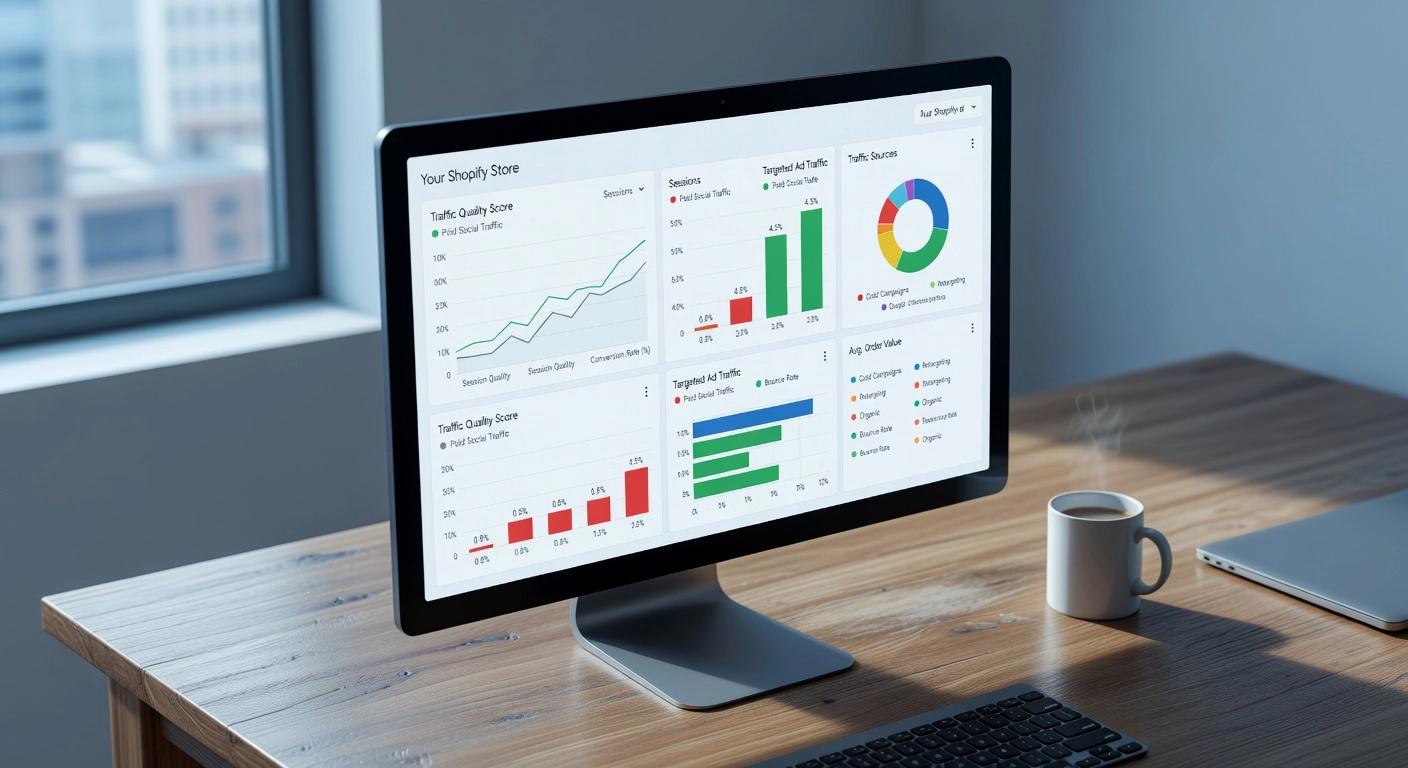
Prerequisites: Email list segmented by purchase history. Materials: Klaviyo or Shopify Email for flows. Allocate 40-50% of budget to email nurture sequences, which convert at 5%+ due to proven intent. Supplement with direct traffic via branded search and loyalty links. Happy Oak Ecommerce specializes in this ad efficiency, restructuring campaigns to cut low-intent waste by 30-40% without sacrificing volume. Expected outcome: Overall traffic quality rises, pushing store-wide conversions toward top 20% performers at 3.2%+.
Step 3: Implement Ad-to-Conversion Funnels with UTM Tracking
Prerequisites: Analytics prerequisites from prior setup. Materials: UTM builder tool, spreadsheet for audits. Tag every ad link (e.g., utm_source=google&utm_medium=cpc&utm_campaign=lookalike_shoes). Track mid-funnel events like Add to Cart in Shopify Reports. Weekly, exclude campaigns under 1.5% conversion or those inflating ROAS via retargeting bias. Expected outcome: 20% waste reduction, clearer ROAS insights per Shopify conversion guide.
Step 4: Leverage 2026 AI Ad Personalization
Prerequisites: AI app integration (e.g., Shopify Magic). Materials: Dynamic creative tools. Deploy AI for real-time creatives adapting to user behavior, weather, or history, boosting engagement 20%+. Use competitor intel features for pricing-matched bidding. Expected outcome: 10-15% conversion gains via hyper-personalization.
Happy Oak Ecommerce clients routinely see 30% ad spend reductions and +2% absolute conversion increases through these targeted shifts, as in cases with $20K+ monthly budgets. Reallocate savings to scale high-intent channels for sustained profitability. Next, refine on-site elements to capitalize on this premium traffic.
Boost Site Speed and Mobile Optimization
With your analytics tracking high-intent traffic from targeted ads, the next step to increase Shopify store conversions is boosting site speed and mobile optimization. Slow pages cause 7% conversion drops per 1-second delay, according to Yotpo data, while mobile traffic (79% of sessions) converts at just 1.2% versus desktop’s 1.9%. Target load times under 2 seconds to minimize bounces and build trust.
Step 1: Audit and Benchmark Speed
Start by running Google PageSpeed Insights on your homepage, product pages, and checkout. Aim for Largest Contentful Paint (LCP) under 2.5 seconds; anything slower spikes abandonment by over 50% on mobile. Note diagnostics like render-blocking resources, then retest after changes. Prerequisites: Access your store URL and Google account. Expected outcome: Identify top issues in 5 minutes.
Step 2: Prioritize Mobile Optimization
Mobile demands tappable CTAs (>48px), legible fonts (>16px), and frictionless navigation. Compress images to WebP format (30% size reduction) and enable lazy loading to defer off-screen assets. Use Shopify’s theme editor for these no-code tweaks. For 79% of your traffic, this bridges the 58% conversion gap.
Step 3: Leverage Shopify Apps
Install TinyIMG for automatic image optimization and lazy loading (learn more), or Booster Theme for preloading and minification. Limit to 2-3 apps to avoid bloat (each adds 150-300ms). Test via Shopify’s speed benchmarks.
Step 4: Meet Core Web Vitals
Optimize for LCP <2.5s and First Input Delay (FID) <100ms; poor scores will hurt 2026 SEO rankings via higher bounces. Preload hero images and defer scripts.
Step 5: Test and Measure Uplift
Run A/B tests in Shopify Analytics post-optimization. Expect 0.5-1% conversion lift, compounding with traffic gains for substantial revenue growth. Monitor weekly for sustained results.
Enhance Product Pages and Trust Signals
With your site speed optimized and high-intent traffic flowing from targeted ads, the next critical step to increase Shopify store conversions is enhancing product pages with compelling visuals and robust trust signals. These elements directly address trust gaps that contribute to 70% cart abandonment rates. Expect a 1-2.5% overall lift from combined tactics, pushing top performers toward 4.7%+ rates. Prerequisites include access to your Shopify admin, image editing tools like Photoshop or Canva, and apps for reviews or AI upsells. Test changes via Shopify’s A/B tools for measurable results.
1. Implement High-Res Images, Videos, 360° Views, and Clear CTAs
Upload 5-8 high-resolution images per product, including multiple angles, zoomable close-ups, lifestyle shots, and scale references for context. Add 30-60 second videos showing 360° spins or in-use demos to boost engagement by 30% or more; compress files to WebP format with lazy loading to maintain sub-2-second loads. Position a prominent “Add to Cart” CTA above the fold in contrasting colors (e.g., bold green on white), make it sticky on mobile (48x48px minimum), and pair with subtle scarcity like “Only 3 left in stock.” This setup guides intermediate users to action without friction. Learn Shopify best practices for product detail pages. Outcome: 20-30% higher add-to-cart rates.
2. Add Reviews for Proven Conversion Lifts
Install a review app to display star ratings and 10-50 verified reviews above the fold, enabling filters by size or fit. Displaying reviews delivers a 76.7% conversion lift (Yotpo data), while interactors are 160% more likely to buy. Collect feedback via automated post-purchase emails, incentivizing photos for visual proof. Include AI-generated summaries to highlight key themes like durability. Outcome: Immediate 50-75% uplift in purchase intent.
3. Display Shipping Transparency, Free Returns Badges, and Urgency Timers
Show estimated shipping costs pre-cart, free shipping thresholds (e.g., “Free over $50”), and “30-Day Free Returns” badges near the price. Add countdown timers for limited stock or flash sales to create genuine urgency, boosting conversions 10-25%. These reduce abandonment by 18-20% from hidden fees. Outcome: 15% average order value increase as shoppers qualify for perks.
4. Integrate UGC Galleries and Size Charts
Curate user-generated content galleries from customer photos or videos, filtered by attributes like body type for fashion or results timeline for health products. Add interactive size charts with AR previews to cut returns 5%+ in apparel (1.9-3.1% baseline) or wellness niches. Explore UGC impact on conversions. Outcome: 50% higher trust and 20% CR gain.
5. Deploy Personalized Bundles and AI Upsells
Use AI apps for “Frequently Bought Together” bundles based on browsing history, doubling conversion rates per Shopify tests. Recommend cross-sells at checkout for 10-30% revenue growth. Outcome: 20% sales uplift with minimal effort.
Iterate with analytics to refine, setting the stage for checkout streamlining.
Streamline Checkout to Cut Abandonment
With your product pages fortified with trust signals and high-intent traffic optimized, the checkout stage often determines if visitors convert or abandon carts at rates exceeding 70%. Streamlining this process can recover 35-50% more sales, directly boosting Shopify store conversions. Prerequisites include Shopify Analytics enabled from prior steps and a store on the latest theme supporting checkout extensibility. Expect 20-40% abandonment reductions within weeks of implementation.
Step 1: Migrate to One-Page Checkout and Enable Guest/Shop Pay. Shopify mandates one-page checkouts by August 26, 2026, for non-Plus stores to avoid functionality loss. Access Settings > Checkout in your admin, enable guest checkout, and activate Shop Pay for one-tap payments. This combo delivers up to 50% higher conversions than traditional flows, as Shop Pay is four times faster. Test on a staging theme first; top stores see immediate lifts from reduced steps.
Step 2: Display Transparent Costs Upfront. Extra fees cause 39% of abandons, while delivery concerns add 21%, totaling 70% impact. Install apps like dynamic shipping calculators to show estimates, taxes, and totals pre-checkout. For details on Shopify benchmarks, see average cart abandonment rates. Update product pages with free shipping thresholds; this transparency alone cuts drop-offs by 20-30%.
Step 3: Add Progress Indicators, Auto-Fill, and Local Payments. Implement progress bars via apps like Checkout Progress Bar, enable browser auto-fill in checkout settings, and integrate local options such as Alipay for 50-100% lifts in Asia. These reduce friction for mobile users (85% abandonment risk). Outcomes include 10-25% completion boosts.
Step 4: Launch Abandoned Cart Emails. Use Shopify’s native tool or apps for multi-touch sequences: first email at 1 hour, follow-ups at 24/72 hours with 10-15% discounts. Recover 10-15% of lost sales, scaling to 20-30% with personalization.
Step 5: Test One-Click Upsells Post-Purchase. On Thank You pages, deploy apps like Aftersell for A/B tested bundles using stored data. Run tests over 2 weeks with 200+ impressions to lift AOV 20-30%. Monitor via Analytics for sustained gains.
Add Personalization and Social Proof
With your checkout streamlined to minimize 70%+ abandonment rates, the next step to increase Shopify store conversions is layering in personalization and social proof. These tactics leverage AI, customer data, and authenticity to double rates from the 1.4-1.8% average toward top 10% benchmarks of 4.7%+. Expect 10-40% revenue lifts and 10-30% AOV gains when implemented systematically.
1. Deploy AI Recommendations and Smart Search
Install Shopify’s Search & Discovery app or AI tools like those integrating with your theme. Analyze browsing history, purchases, and context like weather for dynamic suggestions on product pages, homepages, and carts. Shopify trends confirm this doubles conversion rates, with 10-15% sales uplifts common. Test placements via A/B (e.g., “Customers also bought” sections); 72% of shoppers engage only personalized content. Outcome: 288% boosts in high-intent scenarios, per e-commerce benchmarks.
2. Launch Gamified Loyalty Programs
Prerequisites: Segment customers by purchase history using Shopify Analytics. Use apps like Smile.io for points, tiers (Silver/Gold), and challenges. A 5% retention increase boosts profits 25-95%, as repeat buyers spend 67% more; ROI hits 200-400%. Send omnichannel rewards via email/SMS. Gamification via leaderboards drives emotional engagement, recovering 62-70% lost revenue. Track CLV uplift post-launch.
3. Amplify UGC and Respond Proactively
Collect user photos/videos/reviews via post-purchase emails; embed on PDPs with Loox or Yotpo. UGC converts 144% higher, generating 162% more revenue per visitor; responding to reviews/DMs raises purchase likelihood by 89%. Feature influencer clips (e.g., TikTok unboxings) and reply within 24 hours. 88% of buyers check reviews first. Outcome: 77% conversion lift from displays.
4. Activate Segmented Emails and Dynamic Homepages
Use Klaviyo for behavioral segments (e.g., abandoned carts); personalize with dynamic blocks. This yields 6x higher transactions/AOV, $36 ROI per $1 spent. Adapt homepages to show past-viewed items. 76% prefer tailored brands.
5. Integrate Shoppable Video Reels for 2026
Embed Tolstoy or Shopify’s video tools for AR-enabled reels on PDPs. Users are 65% more likely to purchase; forecast $20B+ in short-form sales. A/B test personalized livestreams. Mobile-optimize for 79% traffic.
Monitor via GA4; iterate weekly for 1-2.5% compounded gains. This positions your store for hyper-personal 2026 dominance.
Conduct A/B Testing and Analytics Deep Dives
With your personalization and social proof elements in place, the definitive way to increase Shopify store conversions is through systematic A/B testing and analytics deep dives. This iterative process validates optimizations, uncovers hidden leaks, and compounds gains, often delivering 10%+ lifts for scaling stores. Prerequisites include your existing Shopify Analytics and Google Analytics 4 setup from earlier steps; aim for 50,000+ monthly visitors for reliable results. Expected outcomes: propel your rate from the median 1.4-1.8% toward top 10% performers at 4.7%+.
1. Test Headlines, CTAs, and Product Pages for Immediate Lifts
Start by prioritizing high-traffic pages like product pages and homepages. Formulate hypotheses, such as “An action-oriented CTA like ‘Add to Cart Now’ versus ‘Learn More’ boosts add-to-carts by 10%.” Use split testing to compare variants; industry data from RedStag Fulfillment shows headline and CTA tests alone yield +0.3-0.8% absolute conversion lifts. Combine with product page tweaks (e.g., trust badges, dynamic images) for +1-2.5% total gains. Run each test for 2-4 weeks or 500+ sessions per variant to achieve 95% statistical significance. Document results in a shared spreadsheet, noting revenue per visitor impacts.
2. Leverage Proven A/B Testing Tools
Select tools integrated with Shopify for seamless execution. Shopify Draft Orders suit low-traffic manual tests by simulating orders without live impact. For advanced needs, deploy VWO’s visual editor for multi-device behavioral targeting and AI-generated ideas; note Google Optimize ended in 2023, so pivot to Shopify’s native Rollouts for theme splits. Additional options like Replo enable no-code product page edits starting at $39/month. Install via the Shopify App Store, connect to GA4, and use sample size calculators to plan tests efficiently.
3. Conduct Funnel Analysis to Pinpoint Leaks
Access Shopify Analytics > Reports > Behavior to map your 5-stage funnel (session to purchase). Segment by device (mobile at 1.2% CR lags desktop’s 1.9%) and traffic source (paid social at 0.8-1.2% versus organic’s 3.6%). Identify drop-offs, like 40-60% early exits signaling messaging mismatches. Apply fixes: urgency timers for cart leaks, shipping transparency for late-stage. Review monthly with heatmaps for user behavior insights.
4. Monitor Weekly and Scale Winners
Schedule weekly KPI reviews (CR, AOV, revenue/visitor) to kill losers and expand victors site-wide. Aim for one test per week; compound 52 annual iterations for hyper-growth.
5. Sync with Ad Platforms for ROAS Optimization
Integrate via Shopify’s Google/Meta pixels and server-side tracking (e.g., CAPI) to attribute ad-driven conversions accurately. Test offer variants by traffic source, recovering 30-40% lost data amid privacy shifts. This elevates ROAS, aligning with targeted ad strategies for sustained profitability.
Incorporate 2026 Trends for Sustained Growth
With your A/B testing and core optimizations established, sustain long-term growth to increase Shopify store conversions by integrating 2026 trends. These forward-looking tactics leverage AI, immersive experiences, and data-driven personalization to push rates from the 1.4-1.8% average toward top 10% benchmarks of 4.7%+. Follow this step-by-step guide, assuming you have Shopify Analytics active and high-intent traffic flowing.
Step 1: Deploy AI/LLM for Personalized Copy and Chatbots. Install apps like Shopify Sidekick or Yotpo integrations via the app store. Train LLMs on customer data for dynamic product descriptions and emails matching browsing history; for example, tailor recommendations that double conversion rates. Add proactive chatbots for real-time consultations, converting 30-67% of interactions. Test variations: personalized copy lifts engagement by 72%, as 90% of shoppers share data for relevance. Expected outcome: 15-30% uplift in sessions to purchase.
Step 2: Integrate Video/AR Try-Ons and In-Person Loyalty Events. Embed 30-60 second shoppable videos and AR tools natively or via apps for virtual try-ons in fashion or beauty. Combine with hybrid events, like pop-ups linked to AR previews, using gamification for UGC shares. Loyalty programs with tiers boost retention 5%, yielding 25%+ profit gains. Outcome: Reduced returns, higher engagement in mobile-heavy traffic (79%).
Step 3: Launch Hyper-Personal Rewards and Pricing Automation. Use Shopify Analytics for AI-segmented rewards: points for reviews or referrals, 5-25x cheaper than acquisition. Automate competitor pricing with dynamic apps adjusting to demand. 56% repurchase with tailored incentives. Outcome: 20-40% loyalty lift.
Step 4: Add Rich Snippets for SEO. Implement JSON-LD structured data on product pages for stars, prices, and images; test with Google’s tool. Boosts clicks 25-82%, with review interactors 160% more likely to buy. Outcome: Organic traffic surge.
Step 5: Partner with Happy Oak for Ad-CRO Integration. Engage Happy Oak Ecommerce to fuse targeted ads (lookalikes, retargeting) with CRO audits, heatmaps, and custom funnels. Their expertise optimizes ad efficiency, cutting waste from 0.8-1.2% paid social rates. Outcome: Scaled 30%+ lifts for profitability.
Implement iteratively; monitor via analytics for 3-5%+ sustained CR.
Actionable Takeaways and Next Steps
Prioritize Your Top Three Gaps for Quick Wins
To increase Shopify store conversions rapidly, focus on the highest-impact gaps identified in your audit: traffic quality, checkout streamlining, and reviews. Traffic quality stands out because cold paid social yields just 0.8-1.2% conversion rates, while high-intent sources like email hit 5% or more; audit your sources via Shopify Analytics and shift budgets to lookalikes and retargeting for immediate uplift. Checkout abandonment exceeds 70% due to hidden costs or friction, so enable one-page checkouts and Shop Pay, which delivers a 50% lift in completions. Reviews provide a 76.7% conversion boost when prominently displayed, as interactors are 160% more likely to buy; integrate apps like native Shopify reviews or UGC feeds on product pages. Tackling these three yields 1-2% gains within weeks, far outpacing averages of 1.4-1.8%. Start by scoring each gap on a 1-10 scale based on your baseline data.
Implement This 4-Week Roadmap
Follow a structured roadmap to execute changes systematically. Week 1: Audit and Baseline. Review Shopify and Google Analytics 4 for CVR by traffic source, device, and funnel stage; document your current 1.4-1.8% average against top 20% benchmarks of 3.2%+. Weeks 2-4: Implement 2-3 Tactics. Select from your prioritized gaps, such as optimizing ads for quality traffic, adding review widgets, and testing Shop Pay; allocate 10-20 hours weekly, using A/B tests for CTAs that lift 0.3-0.8%. Ongoing: Monthly Testing Cycles. Run one multivariate test per month on combined CRO elements, expecting 1-2.5% additive gains; refine based on ROAS trends. This phased approach minimizes disruption while building momentum.
Anticipate Strong ROI and Track Key KPIs
Expect +1-3% conversion lifts to translate into 2-5x profit multipliers on optimized traffic, as even modest CVR improvements amplify revenue without extra ad spend. For instance, a store at 1.5% CVR jumping to 3.2% doubles output from the same sessions. Monitor core KPIs rigorously: Conversion Rate (CVR) aiming for top 20% at 3.2%+, Average Order Value (AOV) via upsells, and Return on Ad Spend (ROAS) targeting 4x+. Use dashboards to segment by mobile (1.2% baseline) versus desktop (1.9%), adjusting tactics accordingly.
Scale with Expert Partnership
For accelerated ad profitability and brand scaling, partner with specialists like Happy Oak Ecommerce. We optimize campaigns to attract targeted visitors, slashing waste from low-intent traffic while boosting profits through efficient scaling. Clients see sustained 3%+ CVR as we integrate these on-site wins with high-ROAS ads. Contact us to audit your setup and roadmap your path to top-performer status.
Conclusion
To elevate your Shopify store conversions beyond the typical 2-3 percent benchmark, focus on these proven strategies: refine product pages for irresistible persuasion, deploy upsells and abandoned cart recovery to capture lost revenue, run A/B tests for data-backed optimizations, and streamline checkout flows to remove all friction. Advanced personalization, urgency triggers, and targeted email sequences further seal the deal by turning casual browsers into repeat buyers.
This guide arms you with battle-tested tactics from top-performing merchants, delivering real, measurable results that scale your revenue.
Take decisive action today: Pick one strategy, implement it immediately, and track your uplift. Your store is primed for explosive growth. Commit now, and watch conversions transform your business into a thriving powerhouse.